Key Findings — SRC-Search EMEA Data 2026
- Women make up 32–36% of the -omics commercial workforce across EMEA, falling to lower representation at senior levels.
- Women close deals at a 54% rate vs 49% for men, and hit 86% of quota vs 78% — yet earn less at every seniority level above entry.
- The average gender pay gap across nine European countries is approximately 8%.
- Junior women (under 5 years’ experience) out-earn men by 1.4% — but the gap reverses and widens to 7.6% by 16+ years.
- The EU Pay Transparency Directive deadline for member states is June 7, 2026.
Each month, SRC-Search analyses salary and representation data across commercial careers in the -omics space. Last month we explored how salaries vary across Europe. This month, we turn to something our data has consistently revealed: a persistent — and in many ways counterintuitive — gender gap in pay and advancement in biotech field sales.
Stereotypes about women in sales — often portrayed as “too soft” or less assertive than their male counterparts — are damaging enough in traditional product sales environments. In biotech, where success depends on consultative skills, active listening, and the ability to navigate complex stakeholder landscapes, these assumptions are supposed to fall apart.
And yet they persist: in hiring decisions, in territory assignments, in performance reviews, and ultimately, in pay packets.
Representation of Women in -Omics Sales Roles
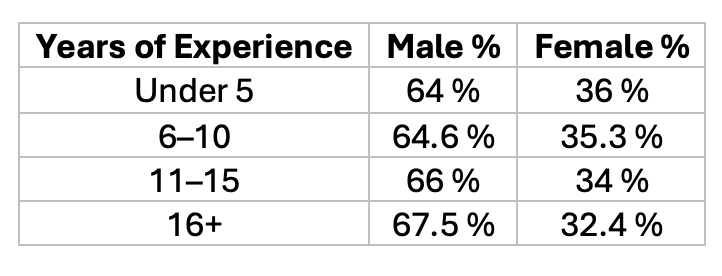
Based on 520 data points collected from EMEA field sales professionals in the -omics space, this sector remains heavily male-dominated — and the gap widens with seniority. Men make up between 64% and 68% of the commercial workforce, with women accounting for 32–36%.
The underrepresentation of women cannot be attributed to any single cause. It is the result of overlapping, mutually reinforcing factors. But before unpacking those, it is worth establishing what makes the picture so striking.
The Performance Paradox: Women Outperform Men — and Are Still Paid Less
Despite being underrepresented across biotech commercial roles, women in -omics sales consistently outperform men on core metrics:
- Research from Xactly (2019) found that women achieve 86% of quota, compared to only 78% for men.
- Analysis by Gong (2017), drawing on nearly 31,000 B2B sales calls, found that women close deals at a rate of 54% compared to 49% for men.
In an industry that prides itself on meritocracy, this creates an uncomfortable reality: the people who are statistically better at the job are being paid less and promoted less frequently. This disparity is especially pronounced in capex sales — typically the highest-earning segment of biotech — where women are even more underrepresented. The gap between demonstrated performance and professional reward is not a coincidence.
The Gender Pay Gap in Biotech Sales: What the Numbers Show
Pay Gap by Country
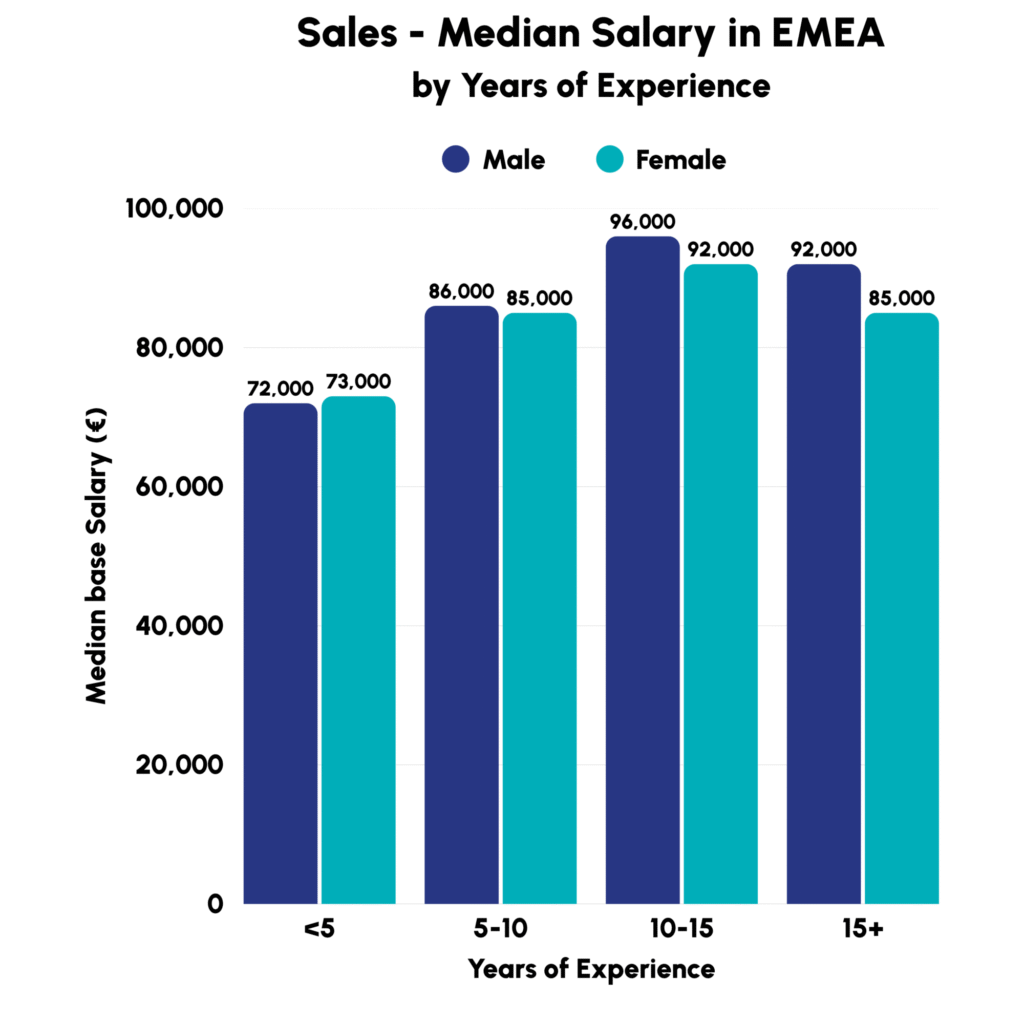
In every country examined, men earn a higher median base salary than women in biotech -omics sales. This is not a regional anomaly — it is a pan-European pattern:
- Switzerland — largest disparity; women earn nearly 25% less than men
- Sweden — gap of approximately 10%, despite strong national equality policies
- England and Scotland — closest to parity, both under 2%
- Nine-country average — approximately 8% gap in favour of men
Pay Gap by Years of Experience
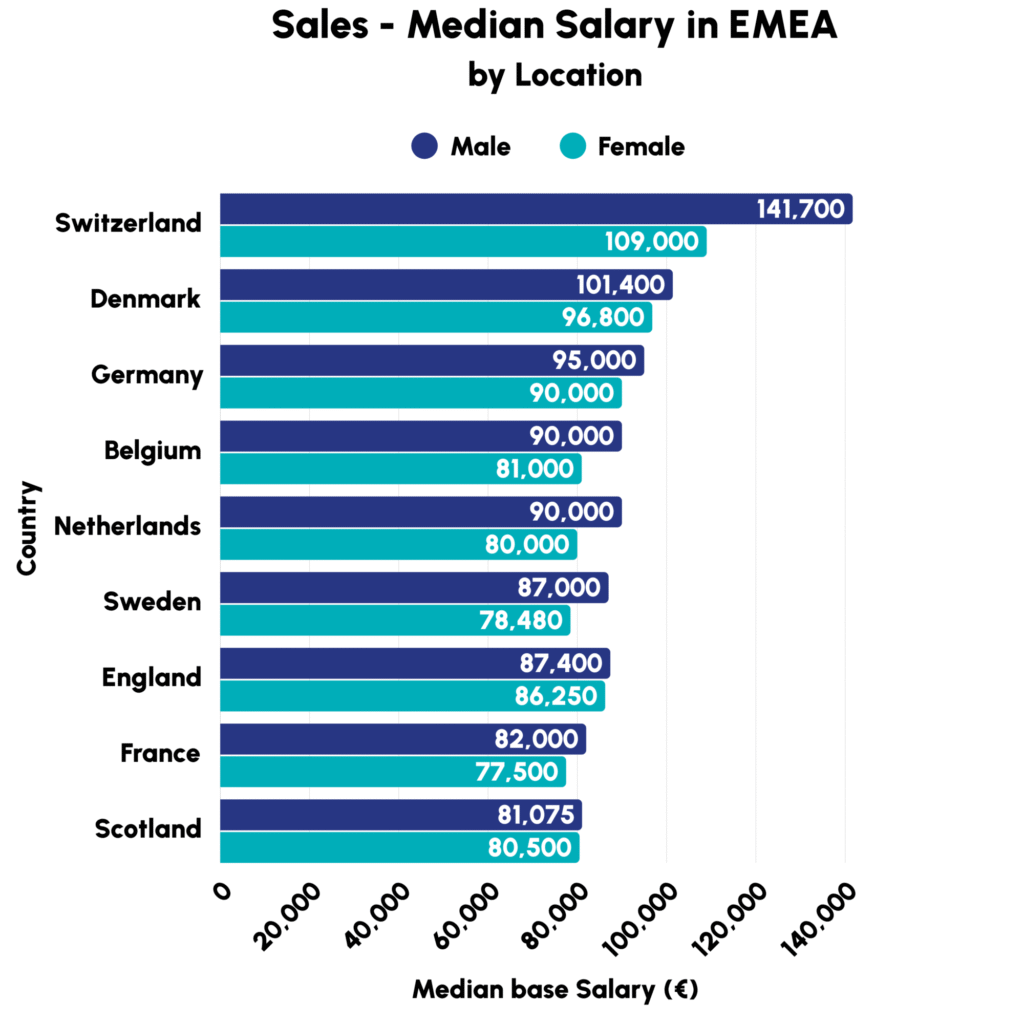
At entry level — under five years of experience — women in biotech sales out-earn men by approximately 1.4%, reflecting active competition for female STEM talent entering commercial roles.
One important piece of context: these experience brackets are not just seniority levels — they are generational snapshots. Professionals with 16 or more years in the field entered biotech sales in a fundamentally different era: fewer female STEM graduates, more rigidly male-dominated commercial structures, and steeper barriers to advancement. Direct comparison between junior and senior cohorts reflects, in part, two generations who built careers under very different conditions.
With that context in mind, the data still warrants scrutiny:
- 0–5 years: women out-earn men by ~1.4%
- 6–10 years: gap reverses; men earn ~1% more
- 11–15 years: gap widens to ~4.2% in men’s favour
- 16+ years: gap reaches ~7.6% in men’s favour
The critical question is whether today’s junior women will maintain their early parity as they progress — or whether the same structural forces will erode it over time.
Why the Gender Pay Gap Persists in Biotech Commercial Roles
The STEM Graduate Pipeline
Commercial roles in biotech increasingly require a scientific foundation, which means the gender balance in STEM education directly shapes who enters these careers. In 2023, men’s share of STEM and life sciences graduates was more than double that of women — making it the most gender-imbalanced field of study in Europe. The relative scarcity of senior women with decades of combined technical and commercial experience is the direct legacy of who was, and was not, being encouraged into STEM disciplines fifteen or twenty years ago. The gap is narrowing — but slowly.
The Motherhood Penalty in Sales Careers
Perhaps no factor is more consequential, or more under-acknowledged, than caregiving-related career disruption. In 2018, 33% of employed women in the EU took a career break for childcare, compared to just 1.3% of men. In sales, where client relationships, territory ownership, and quota attainment are cumulative and continuity-dependent, even a short break can reset years of built-up commercial momentum.
The design of parental leave policy matters as much as its generosity. In Norway and Sweden — where each parent holds a dedicated, non-transferable entitlement — fathers take leave at far higher rates, and the caregiving load is distributed more evenly from the start. Where leave is fully transferable, the default almost always reverts to mothers.
There is also a more fundamental dynamic at play. By the time a couple faces the childcare decision, the woman is typically already earning less than her partner — itself the product of everything described in this article. The numbers make the decision before anyone consciously does. Whatever salary gap existed before the child arrives becomes significantly harder to close afterward.
The Unpaid Work Burden
The motherhood penalty is the most visible part of a broader daily imbalance. Women across Europe carry a significantly larger share of unpaid work — childcare, housework, eldercare, and household administration — than men. The result: 28% of women work part-time, compared to just 8% of men. In sales, where quota targets do not flex, women managing caregiving responsibilities often make up the shortfall in evenings and weekends — hours that are invisible to their employer, unrecorded, and entirely uncompensated. The results get measured. The effort behind them does not.
The Structural Forces Keeping the Gap in Place
Unequal Access to High-Value Accounts and Territories
Territory and account assignment is one of the most powerful — and least scrutinised — levers of income inequality in sales. Women are less likely to be assigned to high-value clients or strategically important territories, directly capping their commission earnings. Research suggests this is frequently rooted in unconscious bias — including assumptions about parental leave — leading managers to hesitate before placing a woman in a pivotal role. The result is a self-fulfilling cycle: lower-value assignments produce lower earnings, which reinforces the perception that women are less commercially impactful, which justifies the next round of lower-value assignments.
The Promotion Gap: High Performance, Low Potential Ratings
The salary gap is inseparable from the promotion gap that precedes it. Female employees consistently receive higher performance ratings than their male counterparts, yet are given lower ratings for potential — and are significantly less likely to be promoted as a result.
“Potential” is a loosely defined metric wide open to unconscious bias. Leadership potential has long been culturally coded as male, and managers often find it harder to picture women in senior roles. Organisations that claim to want only the best performers, yet consistently overlook women at promotion time, are leaving their strongest commercial talent on the table.
This bias has a mirror image in day-to-day performance evaluation. Traits traditionally associated with men — confidence, directness, assertiveness — are rewarded in sales environments. Women who display those same traits are frequently penalised for being too aggressive. Women who take a more collaborative, consultative approach — even when it consistently delivers better results — can find themselves passed over for roles deemed to require a more “forceful” style. Because the benchmark is implicitly male, women are always measured against a standard that was never designed for them.
The Sponsorship Deficit and Female Representation in Management
In 2024, women held only 35% of managerial positions in the EU, and female managers earn approximately 23% less per hour than their male counterparts. The underrepresentation of women in leadership directly shapes who gets mentored, who gets sponsored, and who gains access to the informal networks where the most valuable opportunities are decided.
A more nuanced pattern can compound this further. Senior women who have fought their way up through competitive, often hostile cultures do not always pull others up behind them — a dynamic often called “Queen Bee” syndrome. This is frequently misread as a personality trait; it is better understood as a structural signal. Research found that women who exhibited this most strongly were those who had experienced the highest levels of gender-based discrimination earlier in their careers. The behaviour is a symptom of scarcity, not a cause of it.
Pay Transparency Gaps Prevent Women from Identifying Underpayment
The majority of biotech companies in the EU still lack meaningful pay transparency, making it structurally difficult for women to identify whether they are being paid less than their peers. This is compounded by two consistent patterns: women tend to ask for less when entering a role, and are less likely to move jobs in pursuit of higher pay — two of the most effective levers for accelerating earnings in commercial careers.
A junior woman who does not negotiate assertively enough at the start of her career does not just lose out on that first salary — she sets a baseline that shapes every raise and every offer that follows. Starting lower and staying longer creates a compounding disadvantage that follows women throughout their entire career.
What Can Actually Be Done to Close the Gap?
For Hiring Companies
The EU Pay Transparency Directive requires member states to implement new rules by June 7, 2026, covering salary range disclosure in job postings, a ban on asking for salary history, and pay gap reporting obligations for companies with 100 or more employees. Getting ahead of the deadline — rather than waiting to be pushed — is both strategically and commercially sensible.
- Run a pay equity audit now, and publish salary ranges in job postings.
- Remove previous compensation as an input in offer decisions.
- Audit territory and account assignments: if the highest-value opportunities consistently go to men, that pattern did not emerge by accident.
The business case is straightforward: employees talk. Discovering that a colleague with the same experience earns more does not just sting — it triggers a job search. The few thousand saved on a lower offer tend to disappear quickly when the replacement process starts six months later.
For Hiring Managers
- Build structured, criteria-based promotion frameworks — and document what “potential” actually means.
- The next time a candidate is described as “not quite ready,” ask what “ready” means — and whether it would mean the same thing for a male candidate.
- Require diverse shortlists as a default, not an afterthought.
For Women Navigating These Careers
- Know your market rate and negotiate from it — not from your previous salary. Starting lower compounds across an entire career in ways that are hard to recover from.
- Ask for the salary range early in the interview process. The budget exists before you send your CV — asking what it is is not overstepping.
- Find sponsors, not just mentors. Mentors give advice. Sponsors put their name behind yours.
For Recruiters
- Gender-balanced shortlists should be the starting point, not the exception.
- Anchor all salary conversations to the role and the market — not to what a candidate earned somewhere else three years ago.
If we are being honest, this last point is as much about us as anyone else. Asking candidates for their current or previous salary is something most recruiters do — it is just part of the process. But when that previous salary was itself the product of unequal territory assignments, interrupted careers, and first negotiations that were never challenged, using it as a reference point does not reflect market reality. It moves the inequality one step further down the chain. We are actively examining how we handle this — and we think others should too.
Conclusion: Entry-Level Progress Is Not Enough
The growth in female STEM graduates is visibly reshaping the entry point of biotech commercial careers: junior women in -omics sales are already out-earning their male peers, and the market is responding. But entry-level progress does not automatically translate into equity across a career. The structural forces that have historically disadvantaged women do not disappear simply because more women are entering the field. If those forces are not actively dismantled, today’s junior women risk following the same trajectory as the generation before them — starting strong, and losing ground precisely when experience should be delivering its greatest rewards.
The performance data already shows that women excel in these roles. The rest is a choice about what kind of industry biotech wants to be.
Frequently Asked Questions
Is there a gender pay gap in biotech -omics sales?
Yes. According to SRC-Search data from 520 EMEA field sales professionals (2025), the average gender pay gap in biotech -omics sales is approximately 8% across nine European countries, with men earning more in every country examined.
Do women in biotech sales outperform men?
Yes. Women in B2B sales achieve 86% of quota compared to 78% for men (Xactly, 2019), and close deals at a rate of 54% vs 49% for men (Gong, 2017). Despite stronger performance metrics, women in biotech commercial roles are paid less and promoted less frequently.
Where is the gender pay gap in biotech sales largest in Europe?
Switzerland shows the largest disparity in SRC-Search’s 2026 EMEA dataset, with women earning nearly 25% less than men. Sweden has a gap of approximately 10%, while England and Scotland are closest to parity at under 2%.
Why do junior women in biotech sales earn more than junior men?
At entry level (under five years of experience), women in -omics sales out-earn men by approximately 1.4%, reflecting strong market demand for female STEM graduates entering commercial roles. However, this advantage reverses from the 6–10 year mark and widens steadily with seniority.
What is the EU Pay Transparency Directive deadline?
The EU Pay Transparency Directive requires member states to transpose new rules into national law by June 7, 2026. Requirements include salary range disclosure in job postings, a ban on requesting salary history from candidates, and pay gap reporting for companies with 100 or more employees.
What causes the gender pay gap in life sciences commercial roles?
The gender pay gap in biotech sales is caused by multiple overlapping factors: the gender imbalance in the STEM graduate pipeline, the motherhood penalty from caregiving-related career breaks, unequal assignment of high-value territories, a promotion gap driven by unconscious bias in assessing potential, underrepresentation of women in management, and a lack of pay transparency that prevents women from identifying and challenging underpayment.
About the Dataset
- All salaries are shown in euros. Data from the UK, Switzerland, Denmark, and Sweden were converted using exchange rates as of January 29, 2026.
- Analysis is based on 520 data points collected in 2025 from industry professionals in customer-facing roles across capex, reagents-focused biotech companies, and distributors operating in the broader -omics space.
- Figures reflect base salary only. They do not include bonuses, commissions, pensions, or car allowances.
- Years of experience are calculated from the first relevant full-time, customer-facing role. Academic training and internships are excluded.
This edition was prepared by Dr. Yuliia S., with editorial leadership by Bert Trentelman. Special thanks to the whole SRC-Search team for their data contribution.
SRC-Search publishes regular salary benchmarking data for commercial roles across the -omics space in EMEA. Explore the latest data at SRC-Search.com →